




How to Build a GRC Budget Beyond the Software License

Most GRC budgets begin with a software quote. That leaves out much of the work required to make the program function.
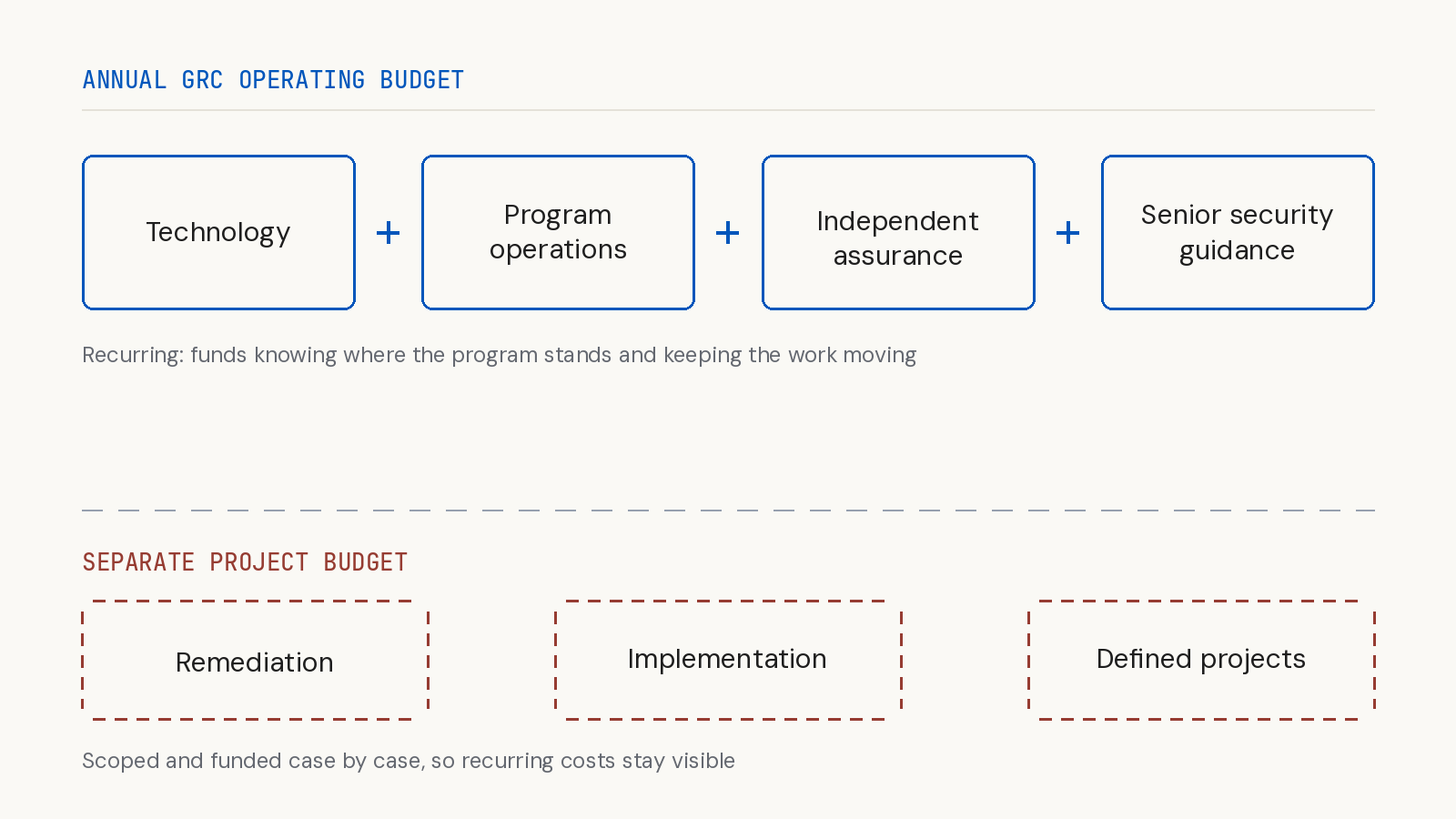
A complete operating budget accounts for the system that organizes the work, the people who maintain it, independent testing and assurance, and the senior judgment required to set priorities. Remediation and defined projects are budgeted separately, so recurring program costs do not disappear inside one-time work. In this article, a GRC operating budget means the recurring cost of governing risk, maintaining compliance work, supporting reviews, and keeping identified work moving. It is not the company's entire cybersecurity budget.
Recurring operating budget = technology + program operations + independent assurance + senior security guidance
Total annual plan = operating budget + remediation and defined projects
Start with the work, not the vendor quote
Software pricing cannot be evaluated until you know what work the software, and the people around it, must support. So before pricing anything, list the work: your regulatory, contractual, customer, and insurance obligations, the frameworks and controls they require, evidence collection and review, policies, risks, and exceptions, vendor reviews, customer security questionnaires, audit preparation, remediation tracking, and leadership reporting. Then write a name next to each item.
That last step is the one most budgets skip, and it is the whole point. Every item is performed by someone, and naming that someone is what turns a software evaluation into a program budget.
The four categories every budget must fund
Technology. The subscription is the visible line. The category also includes onboarding, framework and control mapping, connecting the systems that hold your evidence, and ongoing administration. Budget the first year and renewal years differently, because setup costs do not recur.
Program operations. The recurring execution: maintaining control records, coordinating evidence, updating policies, tracking risks and exceptions, reviewing vendors, answering customer questionnaires, and preparing for scheduled reviews. Software automates collection and reminders. People still validate evidence, resolve exceptions, and act on what the system surfaces. This work is real cost even when it never appears on an invoice, because it is paid in hours taken from the jobs your engineers and compliance leads were hired to do.
Independent assurance. Audits, penetration tests, certifications, and independent assessments. Assurance validates the program from outside the team that runs it, which is a different job than operating it or advising on it. Not every company needs every form of it, but it needs its own line, because blending it into operations or advisory weakens both the number and the independence.
Senior security guidance. Someone senior has to interpret what the program produces: read findings in business context, separate material risks from background noise, recommend priorities and sequencing, and prepare the reporting leadership acts on.
Software shows you where you stand. It cannot tell you what matters most, what to do first, or how to explain it to your board. That takes senior security judgment.
Whether that judgment comes from an internal leader, an external advisor, or both, it needs a line in the budget. An advisor in this role recommends. Leadership decides what to fund and what risk to accept. Programs that fund the machinery without funding the interpretation stall in front of a well-organized backlog.
Budget remediation separately
The GRC program identifies, prioritizes, and tracks the work that needs doing. The doing itself is a different budget: identity changes, cloud hardening, control implementation, vendor replacement, fixes that follow a penetration test. Each needs engineering capacity, an owner, and its own scoped funding.
This is not an argument for leaving remediation out of the plan. It is the opposite. When remediation hides inside recurring GRC costs, the recurring number looks inflated and gets cut, and the fixes lose their owner and quietly stop moving. Keep it visible, as its own project line.
What moves the number
Headcount is a weak predictor of GRC cost. These drivers are better, and each comes with a question you can answer today:
| Driver | Question to answer |
|---|---|
| Obligations carried | Which regulatory, contractual, and insurance obligations bind us this year, and which are coming? |
| Vendors and third parties | How many vendors touch our data, and who reviews them? |
| Customer security reviews | How many questionnaires did sales bring last year? |
| Evidence spread | Where does evidence live, and how much is gathered by hand? |
| Internal ownership | Who owns the program today, and how many hours do they really have? |
| Assurance calendar | What audits, tests, and certifications are due in the next twelve months? |
One caution on frameworks: a control set that spans many frameworks reduces duplicate work, and it is worth building. It does not eliminate the work. Each obligation still brings its own interpretation, evidence expectations, and review cycle. For how assessment work scales, see our guide to choosing a NIST CSF 2.0 assessment provider. Vendor-heavy programs should also work through the third-party AI risk assessment checklist, because vendors keep adding AI features that widen what a review covers.
Three ways to fund the work
Internal team plus platform. Works when the company has clear internal ownership and enough operating capacity. The budget must still include the internal labor and senior leadership time, not only the license. The common planning mistake is counting the license as the whole cost while the labor is absorbed invisibly.
Separate providers and tools. Works when the company needs specialized support from different firms. The budget must include the coordination effort and the work of transferring context between providers, because each one is scoped narrowly and nobody owns the connections by default.
Advisor and platform in one engagement. Works when the company needs senior interpretation and structured program support in the same operating model. The budget must still include internal decision-makers, internal execution, independent assurance, and separately scoped remediation. The engagement supports ownership. It does not replace it.
None of these is universally right. The recurring mistake is the same in all three: funding the tools without funding the judgment.
Five steps to a budget you can defend
- List the work the organization must perform this year.
- Name the person or provider responsible for each item.
- Separate recurring work from defined projects.
- Identify work currently being absorbed without a clear owner.
- Compare operating models on total scope, not software price alone.
A budget built this way is easier to explain, compare, and defend, to a CFO, to a board, and to yourself at renewal. As a CFO turned CISO put it on our podcast, finance funds clarity before it funds anxiety.
Signs the budget is incomplete
- A platform has been purchased, but nobody is responsible for running the process around it.
- Audit preparation becomes an emergency project every year.
- Evidence and reporting are reconstructed for each customer, auditor, insurer, or leadership review.
- Remediation is tracked but has no owner, capacity, or project budget.
- Senior decisions depend on whoever has time to assemble the story.
- Significant internal labor is treated as free because it sits across several departments.
Each symptom points at one of the four categories, which is what makes the framework useful: it tells you which line is missing.
Where Z Cyber fits
Some companies have capable internal teams to implement security work but lack a consistent way to organize the program and apply senior security judgment to it. Z Cyber combines those two layers in one engagement. Glance, Z Cyber's AI-native GRC platform, maps risks and controls, tracks vendors, evidence, remediation, and open work, and supports customer reviews, audit preparation, insurance reviews, and leadership reporting within the agreed scope. The Executive Security Advisor prepares the work, surfaces material issues, explains the tradeoffs, and recommends what should happen next.
The customer decides, approves, acts, and owns risk. Independent assurance, remediation, defined projects, and vCISO authority are separately scoped when required. When comparing this model with a software-only purchase, compare the full operating scope, not only the license fee. From risk to remediation, the program is what you are funding.
Building or resetting your GRC budget?
Z Cyber can help you map the recurring work, identify ownership gaps, and determine what should remain internal, be supported by an advisor, or be handled as a defined project.
Frequently Asked Questions
What should a GRC budget include?
A recurring GRC operating budget covers four components: the technology that organizes the work, the program operations that keep controls, evidence, vendor reviews, and reporting moving, independent assurance such as audits and penetration tests, and senior security guidance to interpret results and recommend priorities. Remediation and defined projects belong in a separate, visible project budget so recurring costs are not distorted by one-time work.
Is GRC software the same as a GRC program?
No. Software organizes the work: it holds controls, evidence, risks, and vendor records, and it can automate collection and reminders. The program is the work itself, performed by people: validating evidence, reviewing vendors, answering customer questionnaires, preparing for audits, and deciding what to fix first. Buying the software without funding the people and judgment around it leaves the program unstaffed.
Should audits and penetration tests be included in the GRC budget?
Yes, as their own line for independent assurance. Audits, penetration tests, certifications, and independent assessments exist to provide validation from outside the team that runs the program, which is a different purpose than operating it or advising on it. Keeping assurance visible as a separate category protects its independence and makes renewal-time comparisons honest.
How should security remediation be budgeted?
As a separate project budget, scoped case by case. The GRC program identifies, prioritizes, and tracks remediation, but the fixes themselves, such as identity changes, cloud hardening, or vendor replacement, need engineering capacity, an owner, and their own funding. Folding remediation into recurring GRC costs hides both numbers and usually starves the fixes.
When does an external security advisor make sense?
When the organization needs senior interpretation of its security and compliance work but a full-time senior hire is not justified yet. An advisor reviews findings in business context, recommends priorities and sequencing, and prepares leadership reporting. The company still decides, approves, acts, and owns its risk, and independent assurance and remediation remain separately scoped.
Subscribe for Updates
Get cybersecurity insights delivered to your inbox.